October 2026 Newsletter
Inside Story
Minimum Wage Is Starting to Catch Up With €30k Salaries
The increase in the National Minimum Wage to €14.94 per hour from 1 January 2027 is more significant than the headline 79-cent increase might initially suggest. For a full-time employee working 40 hours per week, the new minimum wage equates to approximately €31,075 per year (€14.94 × 40 × 52).
This means an employee currently earning €30,000 per annum for a 40-hour week would effectively be earning just €14.42 per hour, putting them below the new statutory minimum. For employers, this creates an important knock-on issue beyond simply increasing the pay of minimum-wage workers. Employees currently earning €31,000, €32,000 or even €33,000 may suddenly find themselves earning only marginally more than the statutory minimum, potentially creating pay compression between entry-level and more experienced roles.
Used responsibly, AI can improve efficiency and help people organise complex information. Used without proper oversight, it can produce inaccurate advice, invented case law, discriminatory outcomes, data protection breaches and workplace decisions that cannot be properly explained or defended.
Employers should therefore use the January increase as an opportunity to review their wider pay structures, not just minimum-wage employees. Alongside this, the increase in the employer PRSI threshold from €552 to €600 per week and the further 0.15% PRSI increase for employers and employees from 1 October 2027 should be factored into workforce budgets. The real story for 2027 is not simply a higher minimum wage. It is the growing pressure it may place on the entire lower end of an organisation’s salary structure.
Inside This Edition
1. Statutory Sick Leave
2. Public Holiday Payments
3. WRC Inspections
4. Case Law Spotlight: Oliveira v Ryanair DAC
Practical actions for employers
Trending Now
Statutory Sick Leave Stays at Five Days
Plans to progressively increase Ireland’s statutory sick leave entitlement have been put on hold, with the Government confirming there are currently no plans to increase the existing five-day entitlement.
The original roadmap had envisaged seven days in 2025 and ten days in 2026, but this progression was frozen amid concerns about the additional costs for employers, particularly in retail, accommodation and food services. For now, eligible employees remain entitled to five days of statutory sick pay per calendar year, paid at 70% of normal gross daily earnings, capped at €110 per day.
For employers, the decision provides some welcome certainty around employment costs, but it is still worth reviewing sick leave policies to ensure the statutory entitlement is correctly reflected and that its interaction with any enhanced company sick pay scheme is clear.
Employer takeaway: Five days remains the statutory position, so there is no immediate expansion to budget for, but employers should keep this area under review as Government policy develops.
Public Holiday Pay: Are You Calculating It Correctly?
With 10 public holidays in Ireland each year, employers need to remember that a public holiday does not simply mean “a paid day off”. Public holiday entitlements are governed by the Organisation of Working Time Act 1997, and eligible employees are entitled to one of four benefits: a paid day off on the public holiday, a paid day off within one month, an additional day of annual leave, or an additional day’s pay. The employer generally decides which benefit will apply. The Workplace Relations Commission (WRC) specifically identifies public holiday entitlements as part of the Organisation of Working Time Act requirements it enforces
-> a paid day off on the public holiday
-> a paid day off within one month
-> additional day of annual leave
-> an additional day’s pay.
The employer generally decides which benefit will apply. The Workplace Relations Commission (WRC) specifically identifies public holiday entitlements as part of the Organisation of Working Time Act requirements it enforces
For an employee who normally works on the day the public holiday falls, the calculation is relatively straightforward. If they do not work because of the public holiday, they should generally receive the pay they would normally have earned for that day.
Example: An employee normally works 8 hours on a Monday and earns €16 per hour:
8 hours × €16 = €128
Their public holiday benefit would therefore generally be based on €128.
The position becomes more important for employees who do not normally work on the day the public holiday falls. Where they qualify for a public holiday entitlement, their benefit is generally calculated at one-fifth of their normal weekly pay.
Example: An employee normally earns €600 per week:
€600 ÷ 5 = €120 public holiday benefit
Part-time employees should not automatically be excluded. Their entitlement depends on meeting the relevant statutory eligibility conditions, so employers should ensure payroll processes correctly distinguish between employees who normally work the day and those who do not. The WRC confirms that statutory holiday and public holiday entitlements apply to employees including part-time workers.
WRC Inspections: Would Your Business Be Ready?
A Workplace Relations Commission (WRC) inspection can be a daunting prospect for any employer, particularly if there are concerns that employment records, payroll practices or workplace procedures may not be fully compliant.
The important thing to remember is that employers should not wait until an inspection is announced before asking the question: “Are we actually compliant?”
WRC inspections can examine an employer’s compliance with a wide range of employment legislation, including areas such as working time and rest breaks, minimum wage, annual leave and public holiday entitlements, employment records and the employment of young persons.
One of the most important areas for employers is record keeping. Having the right policies in place is only part of the picture. Employers also need to be able to demonstrate compliance through accurate records, including hours worked, breaks, leave, pay and the required employee documentation.
Where issues are identified, the consequences can go beyond simply being asked to correct a record. Depending on the legislation and circumstances involved, employers can face compliance notices, fixed payment notices and, in certain cases, prosecution.
How EMGHR Can Help
The best time to prepare for a WRC inspection is before you receive notification of one.
A proactive HR compliance review can identify gaps before they become bigger problems. Employers should regularly check that:
If the answer is no, the document is not ready to be used.
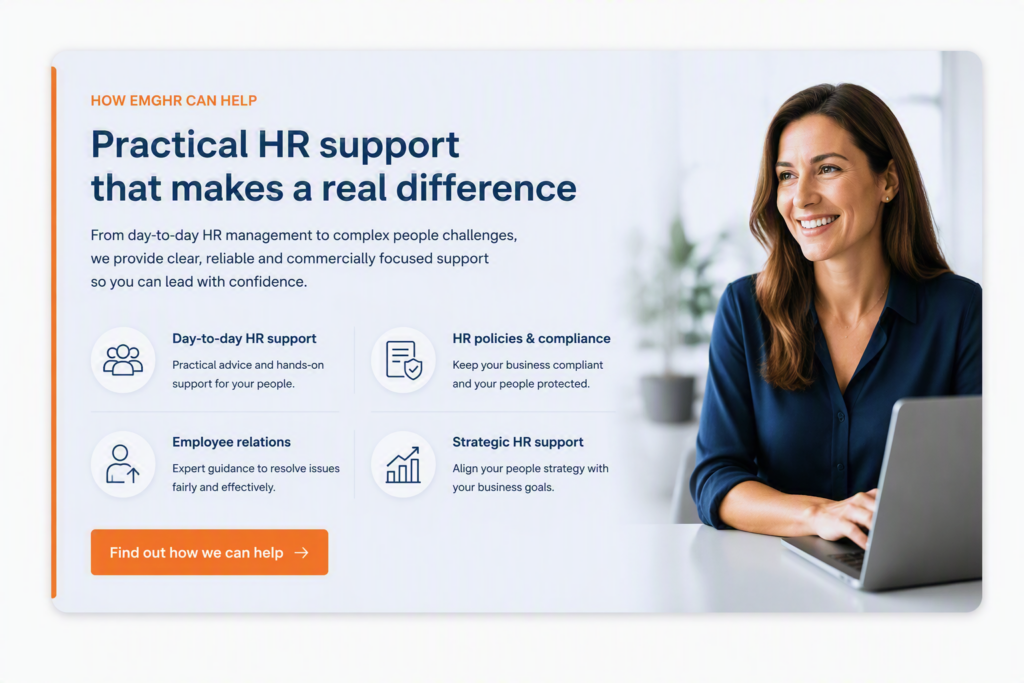
EMGHR can support organisations with:
-> employment contracts and written terms are up to date;
-> working-time and break records are being maintained;
-> minimum wage requirements are being met;
-> annual leave and public holiday entitlements are calculated correctly;
-> payroll and employment records are consistent;
-> policies reflect current employment legislation; and
-> managers understand the procedures they are expected to follow.
Already received notice of a WRC inspection? Don’t panic. EMGHR can help you review your records, identify potential compliance gaps and prepare for the inspection process.
Our advice: Don’t prepare for a WRC inspection because you think one is coming. Run your business as though one could happen tomorrow.
Case Law
Case Number: ADJ-00059324
Stephen Loughran VS Almac Pharma Services Ireland Limited
A recent WRC decision involving Stephen Loughran and Almac Pharma Services Ireland Limited (ADJ-00059324) provides an important reminder that establishing misconduct is only one part of a fair dismissal.
The employee, a production operator, was dismissed for gross misconduct following a physical altercation with a third-party food delivery driver at the employer’s premises. He accepted using offensive language but maintained that he had acted in self-defence after being struck by the driver.
The employer concluded that his actions had gone beyond self-defence and also relied on his offensive language and the potential reputational damage to the organisation when deciding to dismiss him.
However, the WRC found the dismissal to be unfair.
Where did the Employer Go Wrong?
The decision highlights several important issues with how the disciplinary process was handled.
The WRC was critical that the same individual who initiated the investigation and arranged the employee’s suspension subsequently chaired the disciplinary hearing. This concentration of responsibilities was regarded as a serious procedural defect.
There were also concerns around inconsistent witness evidence, allegations developing after the investigation had concluded, and HR’s involvement during the appeal process.
Interestingly, the claimed reputational damage was also found to be speculative. There was insufficient evidence that people outside the organisation had witnessed the incident or that the business had actually suffered reputational harm.
Another notable factor was that the employee had been permitted to continue working for almost a week following the incident before being suspended. This presented an obvious difficulty when subsequently arguing that the incident was sufficiently serious to justify summary dismissal.
The Outcome: Back to Work 15 Months Later
The employee told the WRC that he wanted to return to his job.
Rather than awarding compensation, the Adjudication Officer ordered re-engagement into his previous role or an equivalent position, approximately 15 months after his dismissal.
Importantly, this was re-engagement rather than reinstatement. The intervening period was treated as unpaid suspension, reflecting the fact that the WRC still considered the employee’s use of offensive language to constitute serious misconduct.
Key takeaway for employers:
This case is an excellent reminder that misconduct does not remove an employer’s obligation to run a fair, impartial and proportionate disciplinary process.
Employers should take particular care to:
-> Separate the investigation, disciplinary and appeal stages. Where possible, appoint different and impartial decision-makers at each stage.
-> Be consistent about suspension. If an employee is considered an immediate risk to the workplace, employers need to consider why they are allowing them to continue working before later deciding suspension is necessary.
-> Test conflicting evidence. Material inconsistencies between witnesses should be explored and addressed before a decision is reached.
-> Don’t allow allegations to grow during the process. Employees must understand the allegations against them and have a proper opportunity to respond.
-> Be careful with claims of reputational damage. If reputational harm forms part of the justification for dismissal, employers should be able to demonstrate the risk or actual impact rather than simply asserting it.
The WRC’s subsequent guidance reinforces this point. AI can support drafting and research, but the person submitting the material remains fully responsible for its accuracy and relevance.
EMGHR Comment:
Perhaps the biggest lesson from this case is that an employee can have engaged in serious misconduct and the employer can still lose the unfair dismissal case. The WRC isn’t simply asking, “Did the employee do something wrong?” It is also asking, “Was dismissal a reasonable and proportionate response, and did the employer follow a fair process in reaching that decision?”
Partnership
Introducing EMA: The All – in – One Platform for Growing Businesses
Running a successful business means managing people, clients, compliance, recruitment, sales, and operations, often across multiple disconnected systems.
EMA brings everything together in one powerful platform. Designed specifically for growing organisations, EMA seamlessly connects Customer Relationship Management (CRM), Human Capital Management (HCM), Applicant Tracking (ATS), Learning & Development, and business operations into a single source of truth.
By eliminating duplicate data, streamlining processes, and providing real-time insights, EMA empowers business owners and managers to focus less on administration and more on building high-performing teams, strengthening client relationships, and driving sustainable growth.
Whether you’re attracting top talent, managing employee development, improving sales performance, or enhancing operational efficiency, EMA provides the tools to help your business thrive.
One Platform. One Team. One Vision. EMA.
September 2026 Newsletter
Inside Story
AI in the Workplace: Useful Assistant or Growing Employment Risk?
Artificial intelligence is becoming part of everyday working life. Employers are using AI to screen CVs, draft correspondence, summarise meetings, analyse workforce information and assist with employee relations matters. Employees are also using it to prepare grievances, appeals, responses to disciplinary allegations and submissions to the Workplace Relations Commission.
Used responsibly, AI can improve efficiency and help people organise complex information. Used without proper oversight, it can produce inaccurate advice, invented case law, discriminatory outcomes, data protection breaches and workplace decisions that cannot be properly explained or defended.
With new Irish and EU legislation now in place, employers should no longer treat workplace AI as simply an IT matter. It is increasingly an issue of employment law, equality, data protection, governance and fair procedure.
Inside This Edition
1. AI in grievances, complaints & disciplinary procedures
2. The risks for employees using AI-generated submissions
3. AI in recruitment and candidate selection
4. The latest EU AI Act implementation dates
Ireland’s Regulation of Artificial Intelligence Act 2026
5. Case Law Spotlight: Oliveira v Ryanair DAC
Practical actions for employers
Trending Now
AI in Grievances, Complaints and Disciplinary Procedures
AI tools can help HR teams and managers organise timelines, identify gaps in documentation and prepare first drafts of letters or meeting questions. However, they should not be used to determine whether an allegation is proven, assess a person’s credibility or decide what disciplinary sanction should apply.
An AI system does not understand workplace context in the same way as a trained investigator or decision-maker. It may overlook relevant evidence, misunderstand the applicable policy or create conclusions that sound convincing but are not supported by the facts.
This presents particular risks where AI is used to:
-> Generate investigation findings
-> Assess the credibility of witnesses
-> Recommend disciplinary sanctions
-> Summarise lengthy witness statements
-> Draft grievance or disciplinary outcomes
-> Analyse an employee’s tone, behaviour or perceived emotional state
-> Predict whether an employee is likely to raise a complaint or leave the organisation
Under the EU AI Act, certain uses of AI to infer a person’s emotions in the workplace are prohibited, subject to limited exceptions. This prohibition has applied since 2 February 2025.
Employees Are Using AI Too
Employees are increasingly using AI to draft grievances, complaints, appeals and WRC submissions. AI can help an employee structure their concerns or improve the clarity of a document. The danger arises when the employee relies on AI-generated legal arguments, case citations or factual conclusions without checking them.
On 26 May 2026, the Workplace Relations Commission updated its official guidance for parties using AI to prepare written submissions or evidence. The guidance confirms that the WRC will treat the submission as the party’s own work, even where AI assisted with its preparation. The individual remains responsible for ensuring that the content is relevant, current and accurate.
The WRC identifies several specific risks:
-> AI may provide incorrect legal advice.
-> It may invent legislation, decisions, quotations or case references.
-> It may produce arguments that sound authoritative but do not address the actual dispute.
-> Incorrect material can waste hearing time and create additional work for the other party.
-> Information entered into public AI tools may create privacy or confidentiality risks.
The WRC advises users to verify every legal authority and ensure they understand and can explain everything included in their submission. It also suggests that parties consider voluntarily disclosing that AI assisted with the drafting
AI in Recruitment
Recruitment is one of the areas most directly affected by the EU AI Act.
AI systems may be used to:
-> Screen or reject CVs
-> Rank or shortlist applicants
-> Match candidates to vacancies
-> Analyse online interview responses
-> Target job advertisements
-> Score aptitude or personality assessments
-> Recommend hiring decisions
The WRC confirms that many systems used for recruitment, selection and worker management may be treated as high-risk. Examples include systems used to screen applications, rank candidates, allocate work, monitor performance, assess promotion opportunities or support decisions affecting terms of employment.
Employers should be particularly cautious where an AI tool may reproduce biases contained in historical recruitment data. A system trained on previous hiring decisions may unintentionally disadvantage candidates based on gender, age, disability, race, family status or another protected ground.
Using an external recruitment platform does not necessarily transfer all responsibility to the supplier. Under the EU AI Act, an employer using a system may have responsibilities as a deployer, while additional obligations can arise if the employer develops, substantially modifies or rebrands the system.
Recruitment Questions Employers Should Ask
-> Does the system automatically reject or rank candidates?
-> What information is used to make the recommendation?
-> Has the provider tested for discriminatory outcomes?
-> Is a trained person reviewing the result?
-> Can the organisation explain the decision to an applicant?
-> Are applicants informed appropriately about the processing of their information?
-> Is sensitive candidate information being entered into a public AI tool?
Many AI-powered workplace tools use profiling to assess or predict things about individuals, such as their performance, reliability, behaviour, attendance patterns or even their likelihood of leaving an organisation. By analysing large volumes of personal data, AI systems can identify patterns, generate scores and inform decisions relating to recruitment, promotion, performance management, workforce planning and employee monitoring.
While profiling can improve efficiency and consistency, it also carries significant risks. Employees and candidates may not fully understand how they are being assessed or what factors are influencing the outcome. There is also a risk that AI systems may reinforce existing biases or discriminatory patterns if not properly designed and monitored. Profiling is often used as part of automated decision-making, where technology makes decisions with little or no human involvement, making transparency, fairness and human oversight increasingly important in the workplace.
Human involvement must be meaningful. A manager simply approving an AI recommendation without critically reviewing it is unlikely to provide adequate protection against unfair or discriminatory outcomes.
If AI Gets It Wrong: Understanding the Risks for Employers
While the EU AI Act, implemented in Ireland through the Regulation of Artificial Intelligence Act 2026, which was enacted on July 21, 2026, introduces new safeguards around workplace AI. Employers should be aware that the legal risks associated with AI-driven decision-making extend far beyond the legislation itself. Employees in Ireland can already challenge decisions they believe are discriminatory, unfair, inaccurate, or lacking appropriate human oversight through internal grievance procedures, the Workplace Relations Commission (WRC), or the Data Protection Commission (DPC), depending on the nature of the complaint. Where AI influences recruitment, performance management, promotion, disciplinary action, redundancy selection, or dismissal decisions, employers remain fully accountable for the outcome. The EU AI Act strengthens these existing protections by requiring greater transparency, human oversight, and accountability, while increasing the potential regulatory, financial, reputational, and employee relations risks for organisations that fail to govern AI appropriately. Ultimately, AI may assist decision-making, but responsibility for those decisions will continue to rest with the employer.
The AI Act classifies AI systems used in areas such as recruitment, promotion, performance management and termination as high-risk, requiring employers to implement transparency, accountability and human oversight measures. These principles were further strengthened by the CJEU’s February 2025 ruling in CK v Dun & Bradstreet Austria, which confirmed that individuals have a right to a meaningful explanation of AI-assisted or automated decisions that affect them. In practice, employers must be able to explain how an AI-driven outcome was reached and ensure there is a genuine opportunity for human review and challenge.
How EMGHR Can Help
Before using an AI-assisted HR document, ask:
“Could I explain and defend every factual statement, legal reference and conclusion in this document before the Workplace Relations Commission?”
If the answer is no, the document is not ready to be used.
EMGHR can support organisations with:
-> AI workplace policies
-> AI and HR risk assessments
-> Recruitment process reviews
-> Grievance and disciplinary procedures
-> Workplace investigations
-> GDPR and HR compliance reviews
-> Manager training
-> WRC preparation and case-management support
-> HR documentation and policy updates
AI can bring real benefits to the workplace, but speed must not come at the expense of fairness, accuracy or accountability.
For practical guidance on introducing AI responsibly within your organisation, contact EMGHR.
Case Law
Case Number: ADJ-00055225
Fernando Oliveira V Ryanair DAC
In Fernando Oliveira v Ryanair DAC, a cabin crew employee alleged discrimination on the grounds of race and family status, together with victimisation, harassment and sexual harassment under the Employment Equality Acts. The complaint arose from workplace disputes involving another employee, disciplinary investigations conducted by Ryanair and alleged barriers to training and promotion opportunities. The hearings took place on 20 March 2025 and 12 June 2025, with the decision issued on 1 October 2025 by Patricia Owens, Adjudication Officer of the Workplace Relations Commission.
The complainant submitted extensive written arguments and sought compensation of €170,000 together with the removal of disciplinary sanctions and a review of Ryanair’s internal processes. A significant aspect of the case was that the complainant relied on numerous legal authorities and WRC decisions that the respondent argued were either misquoted, irrelevant, incorrectly described or, in some instances, non-existent. The respondent submitted that the documents appeared to have been generated with the assistance of AI and contained what were described as “phantom citations”. The complainant acknowledged he may have used AI and argued that he was entitled to do so.
The Adjudication Officer ultimately rejected all elements of the complaint. She found that the complainant failed to establish a prima facie case of discrimination, failed to provide evidence linking alleged treatment to his race or family status, and failed to provide cogent evidence supporting claims of victimisation, harassment or sexual harassment. The complaint was found to be not well founded
The AI Issue
While the substantive discrimination claim failed, the most interesting aspect of the decision for employers is the commentary relating to AI-generated submissions.
The Adjudication Officer stated that she was not particularly concerned about whether AI had been used in preparing submissions. However, she emphasised that parties remain fully responsible for ensuring that any submissions made to the WRC are accurate, relevant and not misleading. She found that the complainant’s submissions contained citations that were irrelevant, misquoted and, in many cases, did not exist. The decision notes that considerable time was spent by both the respondent and the WRC attempting to verify the authorities relied upon.
The Adjudication Officer concluded that the attempt to rely on “phantom citations” and unsupported allegations could only be described as “egregious” and an “abuse of process”.
This decision has since become one of the key Irish employment law authorities highlighting the dangers of relying on AI-generated legal content without proper verification. It was subsequently referenced within the WRC’s official guidance on the responsible use of AI in WRC proceedings.
Key takeaway for employers:
The decision does not establish that using AI in an employment claim is automatically improper. Instead, it demonstrates that:
-> AI cannot discharge the burden of proof.
-> A polished submission cannot replace supporting evidence.
-> Parties must understand and defend the arguments they submit.
-> Employers benefit from maintaining a clear and itemised documentary record.
-> Evidence, contracts, payslips and contemporaneous correspondence will generally carry greater weight than unsupported AI-generated assertions.
The WRC’s subsequent guidance reinforces this point. AI can support drafting and research, but the person submitting the material remains fully responsible for its accuracy and relevance.
EMGHR Comment:
Artificial Intelligence is becoming a common feature in workplace disputes. Employees are increasingly using AI tools to draft grievances, disciplinary appeals, protected disclosures and WRC complaints. Employers are also using AI to draft investigation reports, correspondence and policy documentation.
This case highlights an important distinction:
Using AI is not the problem. Using AI without verifying the output is.
AI can be an extremely useful administrative and drafting tool, but it cannot replace evidence, legal analysis, critical thinking or professional judgement.
For employers, the key takeaway is not to fear AI but to govern it properly. Organisations should ensure that:
-> AI-generated HR documents are reviewed by a competent person.
-> Legal authorities and references are checked before reliance is placed upon them.
-> Investigations remain evidence-based and independently conducted.
-> HR teams and managers receive training on the appropriate use of AI.
-> Clear AI usage policies are introduced across the organisation.
As the use of AI continues to evolve, employers who combine technology with strong governance, fair procedures and sound HR practices will be best positioned to manage workplace disputes effectively.
Implications for Employers
This case demonstrates several important lessons for employers:
-> AI Does Not Replace Evidence
-> Regardless of how professionally drafted a submission may appear, the WRC will assess the evidence supporting the allegations. Assertions, speculation and unverified AI-generated content will not satisfy the legal burden of proof.
-> Documentation Matters
-> Ryanair successfully defended the complaint because it was able to demonstrate that complaints had been investigated, disciplinary procedures had been followed, appeals had been conducted and administrative errors had been corrected when identified. Employers should maintain robust records of investigations, disciplinary meetings, decisions and appeals.
-> AI-Generated Grievances and Complaints Are Increasing
-> Many HR professionals are now seeing grievances, appeals and WRC submissions drafted using AI tools. While these documents often appear comprehensive, employers should not assume that legal authorities, factual assertions or references relied upon are accurate. Each point should be independently reviewed and verified.
-> Fair Procedures Still Win
-> The decision reaffirmed that employers who follow documented procedures, provide employees with opportunities to respond, conduct investigations and maintain records remain in a strong position when defending complaints.
-> AI Governance Is Becoming an HR Issue
-> As AI becomes more widely used for grievances, disciplinary appeals, investigations and recruitment processes, organisations need clear guidance on how employees and managers can use AI responsibly and appropriately.
Partnership
Introducing EMA: The All – in – One Platform for Growing Businesses
Running a successful business means managing people, clients, compliance, recruitment, sales, and operations, often across multiple disconnected systems.
EMA brings everything together in one powerful platform. Designed specifically for growing organisations, EMA seamlessly connects Customer Relationship Management (CRM), Human Capital Management (HCM), Applicant Tracking (ATS), Learning & Development, and business operations into a single source of truth.
By eliminating duplicate data, streamlining processes, and providing real-time insights, EMA empowers business owners and managers to focus less on administration and more on building high-performing teams, strengthening client relationships, and driving sustainable growth.
Whether you’re attracting top talent, managing employee development, improving sales performance, or enhancing operational efficiency, EMA provides the tools to help your business thrive.
One Platform. One Team. One Vision. EMA.
August 2026 Newsletter
Inside Story
There’s a well-known saying in HR that by the time an employee hands in their notice, you’re already six to seven months too late to retain them. While not a scientific rule, it highlights an important reality: employees rarely make the decision to leave overnight. In most cases, resignation is the final step in a long process of disengagement that may have started months earlier. Concerns about workload, career progression, management support, recognition, workplace culture, flexibility, or remuneration often go unaddressed until the employee has mentally checked out and begun exploring opportunities elsewhere. By the time a resignation letter arrives, the employee has frequently weighed their options, discussed their future with family and friends, and committed emotionally to moving on. This is why proactive retention strategies such as regular one-to-ones, employee engagement surveys, stay interviews, career development discussions, and early intervention by managers are far more effective than last-minute counteroffers. The key lesson for employers is that retention begins long before an employee decides to leave, making it essential to identify and address concerns before they become reasons to resign.
Before an employee reaches the point of resignation, employers should regularly ask:
-> Do our employees feel valued and recognised for their contribution?
-> Do managers have regular, meaningful conversations with their team members?
–> Can employees see a clear path for growth and development within the organisation?
-> Are concerns being identified and addressed before they become frustrations?
-> Do we understand why employees stay, not just why they leave?
Retention is not about making a better offer when someone resigns. It’s about creating an environment where employees choose to stay. The most successful organisations don’t wait for resignation letters to reveal a problem; they actively listen, engage, and respond long before an employee starts looking elsewhere.
Trending Now
Disciplinary Procedures: Building a Fair and Effiective Workplace
A clear and well-structured disciplinary procedure is an essential component of effective people management. It helps employers maintain workplace standards, protect employee rights, and create a fair and respectful working environment. Importantly, disciplinary procedures should focus on supporting improvement and resolving issues constructively, rather than acting as a form of punishment.
Why Every Employer Needs a Disciplinary Procedure
Whether addressing concerns around conduct, performance, attendance, capability, or compliance with company policies, employers must have a consistent process in place to manage issues fairly.
A properly implemented disciplinary procedure:
- Promotes transparency and consistency
- Protects the principles of natural justice and fair procedure
- Encourages early intervention and performance improvement
- Supports managers in dealing with workplace concerns appropriately
- Reduces the risk of claims relating to unfair treatment
In Ireland, the Code of Practice on Grievance and Disciplinary Procedures outlines the importance of fair procedures, impartiality, and the employee’s right to representation throughout the process.
Start with an Informal Process
Not every issue requires a formal disciplinary response. In many cases, concerns can be addressed through informal discussions, coaching, and guidance.
Managers should seek to address minor issues at the earliest opportunity by:
- Explaining the concern clearly
- Setting expectations for improvement
- Providing support where appropriate
- Agreeing reasonable timeframes for improvement
Informal counselling should be viewed as a normal management tool designed to help employees succeed rather than as the first step towards disciplinary action.
When Formal Disciplinary Action Becomes Necessary
When Formal Disciplinary Action Becomes Necessary
If concerns continue despite informal intervention, or where the issue is more serious, employers may need to initiate a formal disciplinary process.
A fair disciplinary process should include:
1. Investigation Stage A thorough and impartial investigation is carried out to establish the facts.
2. Outcome Stage A separate decision-maker reviews the investigation findings and determines whether disciplinary action is warranted.
3. Appeal Stage Employees must have the right to appeal any disciplinary decision to an independent manager who has had no previous involvement in the matter.
This separation of process is critical to ensuring fairness, objectivity, and procedural integrity.
Typical Disciplinary Sanctions
Most disciplinary policies incorporate a staged approach, although employers may reserve the right to move directly to a higher sanction where circumstances justify it.
Gross Misconduct: A Different Approach
Some forms of behaviour are considered so serious that they fundamentally damage the employment relationship and may justify dismissal following a full and fair investigation.
Examples of gross misconduct may include:
- Theft or fraud
- Physical violence or threats of violence
- Serious breaches of health and safety procedures
- Bullying, harassment, or sexual harassment
- Criminal conduct affecting employment
- Deliberate dishonesty or falsification of records
- Substance abuse in breach of company policy
- Serious breaches of confidentiality
While an employee may be suspended pending investigation, suspension should be used carefully and managed in line with company procedures and legal obligations.
Key Considerations for Employers
To ensure disciplinary processes are effective and legally robust, employers should:
✅ Have a written disciplinary policy in place
✅ Ensure all employees receive and understand the policy
✅ Apply procedures consistently across the workforce
✅ Keep detailed records of meetings and decisions
✅ Ensure managers are trained in conducting investigations and disciplinary hearings
✅ Respect the employee’s right to representation and appeal
Final Thoughts
An effective disciplinary procedure is not about punishment. It is about maintaining standards, encouraging improvement, and ensuring that workplace issues are managed fairly, consistently, and professionally.
When employees understand the process and trust that it will be applied impartially, organisations are better positioned to protect workplace culture, maintain productivity, and minimise employment law risk.
How EMGHR Can Help
Managing disciplinary matters can be complex, particularly where investigations, hearings, or allegations of serious misconduct are involved. EMGHR can support your business with disciplinary procedures, workplace investigations, policy development, and manager training to ensure your organisation remains compliant and confident when handling employee relations matters.
Our services include:
✅Employment Law Compliance
✅Manager Training
✅Workplace Investigations / Disciplinary Meetings
✅Grievance Support
Case Law
Case Number: ADJ-00058443
Stirling Taylor V P Mulrine And Sons (Sales) Unlimited Company
A recent Workplace Relations Commission (WRC) decision serves as an important reminder that employers must distinguish between genuine misconduct and an employee’s misunderstanding of company procedures.
Mr Stirling Taylor, a Maintenance Coordinator with over 10 years’ service, was dismissed for gross misconduct after purchasing a tool through a company supplier on behalf of a colleague and arranging the purchase of Guinness Zero kegs for charity events through company channels. The employer alleged that these transactions exposed the company to potential revenue and licensing issues and amounted to dishonesty.
However, the WRC found that the employee had acted openly and transparently throughout. He had paid for the items himself, gained no personal financial benefit, and believed he was acting with the approval of an employee in the accounts department whom he understood had the authority to facilitate such purchases. The Adjudication Officer found no evidence of theft, fraud, dishonesty, or falsification of records.
Total Compensation Awarded
| Description | Amount |
|---|---|
| Unfair Dismissal Compensation | €6,552 |
| Statutory Notice Pay | €5,625 |
| Terms of Employment Compensation | €1,875 |
| Total Award | €14,052 |
Key takeaway for employers:
✅ Ensure employees receive full details of all allegations before any investigation meeting.
✅ Keep investigation and disciplinary stages separate and impartial.
✅ Consider an employee’s length of service, disciplinary record, and intent before deciding on dismissal.
✅ Remember that breaches of procedure do not automatically amount to gross misconduct.
✅ Always provide employees with a written statement of terms and conditions, even where a handbook exists.
Implications for Employers
This case highlights that even where concerns exist about an employee’s conduct, employers must ensure that both the process and the sanction applied fall within the range of reasonable responses expected of a fair employer.
EMGHR Comment:
In this case, the employer characterised the employee’s actions as dishonest and potentially fraudulent. However, the Workplace Relations Commission found that the employee acted openly, paid for the items in full, obtained no personal financial benefit, and reasonably believed he was acting with the approval of a company representative. The Adjudication Officer concluded that the employee’s actions may have been “naïve” or indicative of a misunderstanding of company processes, but they were not dishonest.
The WRC was also critical of the employer’s investigation and disciplinary processes. The employee was not provided with full particulars of all allegations in advance, relevant witness evidence was not disclosed, and there was insufficient separation between the investigation and disciplinary stages. These procedural deficiencies were sufficient in themselves to undermine the fairness of the dismissal.
The financial consequences for the employer extended far beyond the original disciplinary issue. The WRC awarded: €14,052
However, the headline award rarely reflects the true cost of defending an employment claim.
Implications for Employers
Employers should also be mindful of the significant indirect costs associated with defending a WRC case, including:
- Senior management time spent investigating allegations.
- HR involvement throughout the investigation, disciplinary, appeal and hearing stages.
- Legal fees for professional advice and representation.
- The cost of preparing witness statements and hearing bundles.
- Time spent by managers and witnesses attending hearings.
- Potential damage to employee relations and workplace morale.
- Reputational risk arising from published WRC decisions.
- Recruitment, onboarding and training costs if a replacement employee is hired.
- The risk of additional claims where contractual documentation or procedures are found to be deficient.
In many cases, these indirect costs can exceed the compensation ultimately awarded by the WRC.
Partnership
Introducing EMA: The All – in – One Platform for Growing Businesses
Running a successful business means managing people, clients, compliance, recruitment, sales, and operations, often across multiple disconnected systems.
EMA brings everything together in one powerful platform. Designed specifically for growing organisations, EMA seamlessly connects Customer Relationship Management (CRM), Human Capital Management (HCM), Applicant Tracking (ATS), Learning & Development, and business operations into a single source of truth.
By eliminating duplicate data, streamlining processes, and providing real-time insights, EMA empowers business owners and managers to focus less on administration and more on building high-performing teams, strengthening client relationships, and driving sustainable growth.
Whether you’re attracting top talent, managing employee development, improving sales performance, or enhancing operational efficiency, EMA provides the tools to help your business thrive.
One Platform. One Team. One Vision. EMA.
July 2026 Newsletter
Inside Story
As we move further into 2026, employers are facing a number of significant employment law developments that will require careful planning and preparation.
In this month’s HR Update, we highlight three important areas that should be on every employer’s radar: new retirement age legislation, enhanced gender pay gap reporting requirements, and the latest position on Ireland’s implementation of the EU Pay Transparency Directive.
Trending Now
Retirement Age Legislation Now in Effect
The Employment (Contractual Retirement Ages) Act 2025 came into force on 29 June 2026, introducing new rights for employees whose contractual retirement age is below the State pension age of 66.
Eligible employees can now formally notify their employer that they wish to continue working beyond their contractual retirement age. Employers must carefully consider these requests and, where retirement is enforced, be in a position to objectively justify the decision.
Organisations should review retirement policies, contractual retirement provisions and internal processes to ensure compliance with the new legislation and the updated WRC Code of Practice on Longer Working.
Gender Pay Gap Portal Opens to Public View
The public-facing Gender Pay Gap Portal has now been launched, allowing employees, job seekers and the wider public to view and compare gender pay gap data submitted by employers.
While publication on the portal was voluntary during the 2025 reporting cycle, it will become mandatory for in-scope organisations from the 2026 reporting cycle onwards.
Employers should remember that existing obligations to publish gender pay gap reports on their website (or make them otherwise publicly available) remain in place.
With increased public visibility of pay gap reporting, ensuring accuracy, context and a clear action plan has never been more important.
Pay Transparency – More Time, But Not Time to Delay
Although Ireland has missed the EU deadline for transposing the Pay Transparency Directive into domestic legislation, employers should not view this as a reason to postpone preparations.
The Directive will introduce significant changes, including:
✅Greater pay transparency during recruitment
✅Restrictions on salary history questions
✅Enhanced employee rights to pay information
✅Expanded reporting and equal pay obligations
The additional lead-in time provides organisations with an opportunity to review pay structures, identify potential pay equity risks and prepare for what will be one of the most significant workplace compliance changes in recent years.
How EMGHR Can Help
EMGHR supports employers across Ireland with practical, commercially focused HR and Employment Law advice.
Our services include:
✅Employment Law Compliance
✅Retirement Age Compliance
✅Gender Pay Gap Reporting
✅Pay Transparency Readiness
Action Step
Practical Steps Employers Should Be Taking Now
✅ Review contractual retirement ages and policies
✅ Assess readiness for gender pay gap reporting obligations
✅ Audit recruitment and pay practices
✅ Review pay structures and progression frameworks
✅ Train managers on upcoming legislative changes
✅ Ensure policies and handbooks reflect current legal requirements
How EMGHR Can Help
At EMGHR, we support employers with practical, commercially focused HR and employment law advice. Whether you need assistance with retirement age compliance, gender pay gap reporting, policy reviews, employment law updates or ongoing HR support, our team is here to help.
Case Law
Case Number: ADJ-00057991
Mark Brennan V Marks and Spencer Ireland Limited
A recent WRC decision found that a retailer unfairly dismissed an employee whose staff discount account had been misused by his partner and others without his knowledge.
While the WRC accepted that the employer had followed a fair disciplinary process and that the employee had been careless, it concluded that dismissal was a disproportionate sanction. The Adjudication Officer found that a lesser disciplinary penalty, such as a final written warning, could have been appropriate.
The employee was awarded €2,000 compensation, with the award reduced to reflect his contribution to the situation.
Key takeaway for employers:
Even where misconduct is established and procedures are followed correctly, employers must ensure that the disciplinary sanction is proportionate to the circumstances and that less severe alternatives have been properly considered.
Implications for Employers
This decision reinforces that following a fair process alone may not be enough to defend an unfair dismissal claim. Employers must also be able to demonstrate that the sanction imposed is reasonable and proportionate to the misconduct involved.
EMGHR Comment:
This case serves as a useful reminder that the WRC will examine not only whether procedures were fair, but also whether the employer’s decision to dismiss fell within the range of reasonable responses available in the circumstances. Employers should ensure disciplinary decisions are both procedurally fair and proportionate to the facts of the case.
Partnership
EMGHR & Collier Training Partnership
We are delighted to announce our partnership with Collier Training, allowing us to provide clients with access to a broader range of professional training and development solutions.
Areas of support include:
✅Management Development
✅HR Compliance Training
✅Health & Safety Training
✅Leadership Development
✅Workplace Skills Programmes
Together, we are helping organisations build stronger, more capable teams.